Friday, July 8, 2016

PRESENT PERFECT

The present perfect is formed from the present tense of the verb have and the past participle of a verb:
The present perfect continuous is formed with have/has been and the -ing form of the verb:

Use

We use the present perfect tense:
  • for something that started in the past and continues in the present:
They’ve been married for nearly fifty years.
She has lived in Liverpool all her life.
Note: We normally use the present perfect continuous for this:
She has been living in Liverpool all her life.
It’s been raining for hours.
  •  for something we have done several times in the past and continue to do:
I’ve played the guitar ever since I was a teenager.
He has written three books and he is working on another one.
I’ve been watching that programme every week.
We often use a clause with since to show when something started in the past:
They’ve been staying with us since last week.
have worked here since I left school.
I’ve been watching that programme every week since it started.
  • when we are talking about our experience up to the present:

Note: We often use the adverb ever to talk about experience up to the present:
My last birthday was the worst day I have ever had.
Note: and we use never for the negative form:
Have you ever met George?
Yes, but I’ve never met his wife.
  • for something that happened in the past but is important at the time of speaking:
I can’t get in the house. I’ve lost my keys.
Teresa isn’t at home. I think she has gone shopping.
I’m tired out. I’ve been working all day.

 We use the present perfect of be when someone has gone to a place and returned:
A: Where have you been?
B: I’ve just been out to the supermarket.
A: Have you ever been to San Francisco?
B: No, but I’ve been to Los Angeles.
But when someone has not returned we use have/has gone:
A: Where is Maria? I haven’t seen her for weeks.
B: She's gone to Paris for a week. She’ll be back tomorrow.
We often use the present perfect with time adverbials which refer to the recent past:
just; only just; recently;
Scientists have recently discovered a new breed of monkey.
We have just got back from our holidays.
or adverbials which include the present:
ever (in questions); so faruntil nowup to nowyet (in questions and negatives)
Have you ever seen a ghost?
Where have you been up to now?
Have you finished your homework yet?
No, so far I’ve only done my history.
WARNING:
We do not use the present perfect with an adverbial which refers to past time which is finished:
I have seen that film yesterday.
We have just bought a new car last week.
When we were children we have been to California.
But we can use it to refer to a time which is not yet finished:
Have you seen Helen today?
We have bought a new car this week.

Sunday, June 5, 2016

THE INTERVIEW

Hi guys, here you can read the questions of the interview. Please practise them.


Full people description

Hi guys, here you can see more information about physical description of people. According to them write your own description.


FULL DESCRIPTIONS


NOTE: Don't forget to write your own full description for next class according to my  instructions given in class.

Sunday, May 15, 2016

PEOPLE DESCRIPTION

Hi guys! 
Here you are some information about how to describe people.
Pay attention to the positive and negative traits or aspects of people.
You have to learn all these adjectives about people traits, too, you need them to make people descriptions.


PERSONALITY DESCRIPTION

                                               Use the questions:

WHAT ARE PEOPLE LIKE?

What is she/he like?
(¿Cómo es ella/él?)
Use verb to BE to describe personality of people : 


  Question:                                        Answer:
What is lisa like? -->      She is intelligent and loyal.   
                                            She is intelligent but talkative.

                                            Lisa is very intelligent but quite talkative.


POSITIVE PERSONALITY TRAITS
NEGATIVE PERSONALITY TRAITS
charming
encantador
ambitious
ambicioso
cheerful=amusing, funny
divertido, gracioso
absent-minded
distraído, despistado
considerate
considerado
aggressive
agresivo
courageous = brave
valiente
annoying
molesto
creative
creativo
bad-tempered
malhumorado
curious
curioso
bossy
mandón
determined
decidido
cheeky
atrevido
extroverted
extrovertido
clumsy
torpe
frank
franco
two-faced = hypocritical
falso, hipócrita
friendly
amigable
dishonest
deshonesto
generous
generoso
disrespectful
irrespetuoso
gentle=kind, polite, attentive
Gentil, amable, cortés, atento
dominant
dominante
honest = truthful
honesto
boring = dull
aburrido
humble
humilde
envious
envidioso
Ingenious=clever
Ingenioso, listo, astuto
forgetful
olvidadizo
likable / likeable
agradable, simpático
frivolous
frívolo
loyal = faithful
leal
fussy
quisquilloso
modest
modesto
impatient
impaciente
obedient
obediente
impulsive
impulsivo
optimistic
optimista
indifferent
indiferente
organized
organizado
insecure
inseguro
passionate
apasionado
insensitive
insensible
patient
paciente
insolent
insolente
realistic
realista
irascible
irascible
reliable = trustworthy
confiable
irresponsible
irresponsable
respectful
respetuoso
jealous
celoso
responsible
responsable
lazy
perezoso
self-confident
seguro
mean = stingy
mezquino
sensible
sensato
modest
modesto
sensitive
sensible
moody
malhumorado
sincere
sincero
nosey
metido
sociable = outgoing
sociable
pessimistic
pesimista
thankful = grateful
agradecido
proud = arrogant
orgulloso
tolerant = patient
paciente
resentful
rencoroso
understanding
comprensivo
rude = impolite
descortés
hard-working
trabajador
jealous
celoso
romantic
romántico
cruel
cruel
Intelligent
inteligente
shy = introverted
tímido, introvertido
punctual
puntual
strict
estricto, severo
studious
estudioso
stubborn
terco, testarudo
naive
ingenuo, inocentón
understanding
comprensivo
well-educated
bien educado
talkative
hablador
well-behaved (children)
de buen comportamiento
naughty (children)
travieso (niños)
nice
bueno, agradable, lindo
weird
raro


PHYSICAL DESCRIPTION

Use the questions:
WHAT DO PEOPLE LOOK LIKE?

What does she/he look like?

(¿Qué apariencia tiene ella/él?)

Tuesday, May 10, 2016

Prueba ELSK – 2016

Hola chic@s de grado 8, quiero recordarles que el día de mañana 11 de mayo se llevara a cabo la aplicación de la prueba institucional de inglés ELSK de 6:00 - 7:00 AM. 
Favor llevar lápiz, borrador y $400 para las fotocopias.
See you tomorrow guys!

Saturday, April 30, 2016

Simple Present Tense

Hi Guys of 8A, 8B, 8C, 8D and 8E, this information is about the simple present tense. Read it and write it in your notebooks.

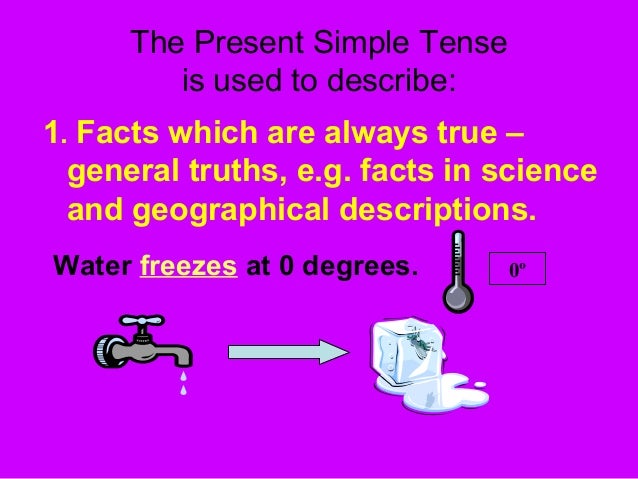
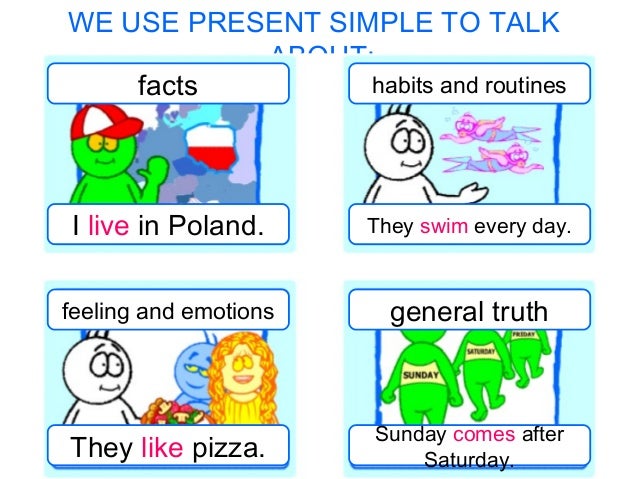
The simple present tense in English is used to describe an action that is regular, true or normal.
We use the present tense for:

1. Repeated or regular actions in the present time period.
  • take the train to the office.
  • The train to Berlin leaves every hour.
  • John sleeps eight hours every night during the week.

2. Facts.
  • The President of The USA lives in The White House.
  • A dog has four legs.
  • We come from Switzerland.
3. For habits and routines.
  • get up early every day.
  • Carol brushes her teeth twice a day.
  • They travel to their country house every weekend.
4. Things that are always / generally true.
  • It rains a lot in winter.
  • The Queen of England lives in Buckingham Palace.
  • They speak English at work.

5. Feeling and emotions.
  • I dislike selfish people.
  • she hates Reggaeton music.

Verb Conjugation & Spelling

We form the present tense using the base form of the infinitive (without the TO).
In general, in the third person we add 'S' in the third person.
SubjectVerbThe Rest of the sentence
I / you / we / theyspeak / learnEnglish at home
he / she / itspeaks / learnsEnglish at home

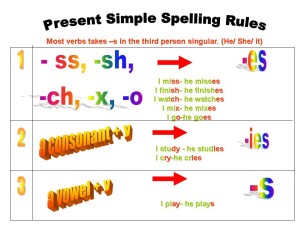
The spelling for the verb in the third person differs depending on the ending of that verb:
1. For verbs that end in -O, -CH, -SH, -SS, -X, or -Z we add -ES in the third person.
  • go – goes
  • catch – catches
  • wash – washes
  • kiss – kisses
  • fix – fixes
  • buzz – buzzes
2. For verbs that end in a consonant + Y, we remove the Y and add -IES.
  • marry – marries
  • study – studies
  • carry – carries
  • worry – worries
NOTE: For verbs that end in a vowel + Y, we just add -S.
  • play – plays
  • enjoy – enjoys
  • say – says

Negative Sentences in the Simple Present Tense

To make a negative sentence in English we normally use Don't or Doesn't with all verbs EXCEPT To Be and Modal verbs (can, might, should etc.).
  • Affirmative: You speak French.
    Negative: You don't speak French.
You will see that we add don't between the subject and the verb. We use Don't when the subject is Iyouwe orthey.
  • Affirmative: He speaks German.
    Negative: He doesn't speak German.
When the subject is heshe or it, we add doesn't between the subject and the verb to make a negative sentence. Notice that the letter S at the end of the verb in the affirmative sentence (because it is in third person) disappears in the negative sentence. We will see the reason why below.

Negative Contractions

Don't Do not
Doesn't = Does not
don't like meat = I do not like meat.
There is no difference in meaning though we normally use contractions in spoken English.

Word Order of Negative Sentences

The following is the word order to construct a basic negative sentence in English in the Present Tense using Don't orDoesn't.
Subjectdon't/doesn'tVerb*The Rest of the sentence
I / you / we / theydon'thave / buy
eat / like etc.
cereal for breakfast
he / she / itdoesn't
* Verb: The verb that goes here is the base form of the infinitive = The infinitive without TO before the verb. Instead of the infinitive To have it is just the have part.
Remember that the infinitive is the verb before it is conjugated (changed) and it begins with TO. For example: to have, to eat, to go, to live, to speak etc.
Examples of Negative Sentences with Don't and Doesn't:
  • You don't speak Arabic.
  • John doesn't speak Italian.
  • We don't have time for a rest.
  • It doesn't move.
  • They don't want to go to the party.
  • She doesn't like fish.

Questions in the Simple Present Tense

To make a question in English we normally use Do or Does. It has no translation in Spanish though it is essential to show we are making a question. It is normally put at the beginning of the question.
  • Affirmative: You speak English.
    Question: Do you speak English?
You will see that we add DO at the beginning of the affirmative sentence to make it a question. We use Do when the subject is Iyouwe or they.
  • Affirmative: He speaks French.
    Question: Does he speak French?
When the subject is heshe or it, we add DOES at the beginning to make the affirmative sentence a question. Notice that the letter S at the end of the verb in the affirmative sentence (because it is in third person) disappears in the question. We will see the reason why below.
We DON'T use Do or Does in questions that have the verb To Be or Modal Verbs (can, must, might, should etc.)

Word Order of Questions with Do and Does

The following is the word order to construct a basic question in English using Do or Does.
Do/DoesSubjectVerb*The Rest of the sentence
DoI / you / we / theyhave / need
want etc.
a new bike?
Doeshe / she / it
*Verb: The verb that goes here is the base form of the infinitive = The infinitive without TO before the verb. Instead of the infinitive To have it is just the have part.
Remember that the infinitive is the verb before it is conjugated (changed) and it begins with TO. For example: to have, to eat, to go, to live, to speak etc.
Examples of Questions with Do and Does:
  • Do you need a dictionary?
  • Does Mary need a dictionary?
  • Do we have a meeting now?
  • Does it rain a lot in winter?
  • Do they want to go to the party?
  • Does he like pizza?

Short Answers with Do and Does

In questions that use do/does it is possible to give short answers to direct questions as follows:
Sample QuestionsShort Answer
(Affirmative)
Short Answer
(Negative)
Do you like chocolate?Yes, I do.No, I don't.
Do I need a pencil?Yes, you do.No, you don't.
Do you both like chocolate?Yes, we do.No, we don't.
Do they like chocolate?Yes, they do.No, they don't.
Does he like chocolate?Yes, he does.No, he doesn't.
Does she like chocolate?Yes, she does.No, she doesn't.
Does it have four wheels?Yes, it does.No, it doesn't.
However, if a question word such as whowhenwherewhywhich or how is used in the question, you can not use the short answers above to respond to the question.

Let's review:

Activity:
  1. Read and write the text about below. 
  2. Use the verbs to complete the text. 
  3. Re-write the text in 3rd person singular.

CÓDIGOS PARA REGISTRO EN EDMODO

Buenos días queridos estudiantes de 7 y 8 grado. A continuación les dejo el código correspondiente a cada curso para que se registren en l...