Friday, March 27, 2015

Present Continuous

Hi guys!
This information is about the Present Continuous. 

USE
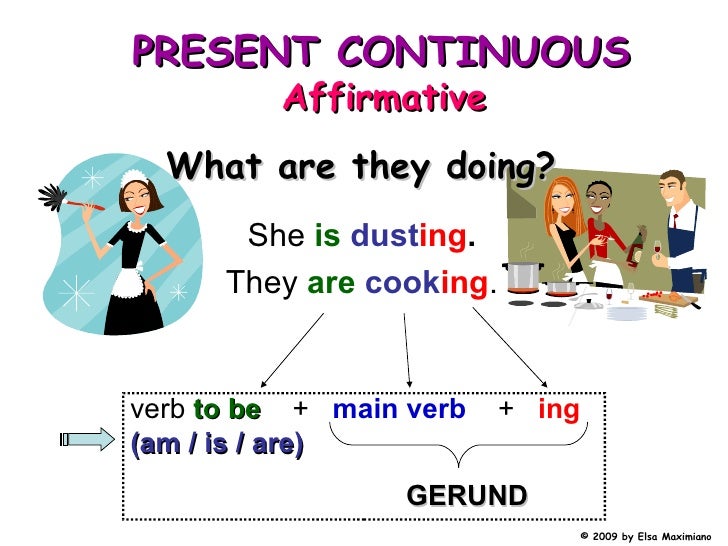
Use the Present Continuous with Normal Verbs to express the idea that something is happening now, at this very momento or actions in progress now.


FORM
Affirmative form: 
[S + (am/is/are) + Ving + C] 
You are watching TV.

Negative form:
[S + (am/is/are) + NOT + Ving + C]You are not watching TV.

Interrogative form: 
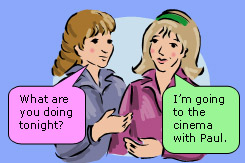
[(WH-) + (am/is/are) + S + Ving +C]
What are you watching?   Are you watching TV?  (yes/no question)

 
Examples:
·       You are learning English now.
·       She is not swimming now.
·       Are you sleeping?
·       I am sitting.
·       I am not standing.
·       Is he sitting or standing?
·       They are reading their books.
·       They are not watching television.
·       What are you doing?
·       Where is Samuel working?

Spelling rules:
Form he Present continuous by adding –ing directly to the infinitive of the verb:
Read à Reading
Do à Doing
Talk à Talking
Play à Playing
Wath à Watching

Exceptions:
Verbs that ends in e, omit the vowel and add –ing.
Have à Having
Practice à Practicing
Make à Making
Come à Coming
Write à Writing

Verbs of one syllable that end in a vowel + a consonant, double the final consonant and add –ing.
Put à Putting
Cut à Cutting
Sit à Sitt ing
Swim àSwimming


Don’t use the verbs like, hate, know, uderstand in present continuous.
Incorrect: I am liking this ice cream  
Correct: I like this ice cream


ACTIVITY:
Read the text.

It’s a rainy Saturday. It’s raining a lot and Mary and her family are spending the afternoon at home. Her uncles are visiting them. Mary and her father are in the living room. Mary is making a draw and her father, Mr.Harris, is surfing on the net. They are also talking.
Mary’s older brother, Peter, is in his bedroom playing computer games. He is a computer fanatic and he spends much time playing on the computer. His little brother, Jim is also in the living room. He is playing with his dinosaurs’ collection. Sometimes he teases Mary, he is a really naughty boy.
Mary’s mother, Mrs. Harris, is in the kitchen preparing a snack for all of them. She is making some tea and talking to Mary’s uncles, Lucy and Tom. They are from the nearest town and stopped by to say hello.
Fluffy, the family cat, is sleeping on the kitchen’s sofa. We can’t see him in the picture, but he is a true fluffy cat.

Sunday, March 15, 2015

Daily Routines

Hi boys and girls of 8A, 8B and 8C!
Read the daily routines, then look up all the unknown words in a dictionary and learn the new vocabulary.

Arnold's daily routine
   Arnold is an English schoolboy. He’s thirteen. He doesn’t have a very interesting life. He goes to school every day except Saturdays and Sundays.
    On schooldays he gets up at seven o’clock. He has a shower and then he has breakfast. He usually has a boiled egg, toast and jam. He goes to school at eight o’clock. He usually goes by bus, but when the sun is shining he walks. School starts at nine o’clock and Arnold has lessons until quarter to one.
   The lunch break is from quarter to one to two o’clock. Arnold always has a hamburger and chips for lunch. After lunch he has more lessons until four o’clock. Then he goes home.

   When he gets home, he does his homework. Then he has dinner at quarter to seven. His favourite dinner is steak and chips. After dinner he watches television. He goes to bed at eleven o’clock.

Susan’s daily routine
Susan is thirteen years old and she attends a very big school near London. Her favorite subjects are Science and Physical Education.
She is very good at sports.  She plays volleyball at her school. Susan has a busy life. She always gets up at a half past seven. She has a shower, gets dressed and   at eight o’clock she goes to school by car with her mother. Her classes start at half past eight.
Her mother is a teacher at Susan’s school.
On Mondays Susan has lunch at school with her friends. On Tuesdays and Thursdays she practices volleyball at the school’s gym. Wednesday is Susan’s favourite day of the week because she has dance classes and sometimes she has dinner with her father. Susan’s parents are divorced. She lives with her mother and at the weekends she always goes to her father’s house.
On Saturdays Susan goes for a walk* with her dog Nikita. After having lunch with her father, Susan goes to the cinema with some friends. At 4:40 pm Susan goes home and listens to music in her bedroom. She loves music. At 9:45 she goes to bed. She never goes to bed late.

Mark's daily routine
Every weekday, Mark gets up at 6:45 and then takes a shower. He normally doesn’t have breakfast at home because he doesn’t have enough time. He goes to the office by car and gets there at 7:15, then he has breakfast at the office at about 7:30. Mark is an accountant in a very important exportation company. In the morning he works from 7:00 to 1:00, he usually has a break at 10:30 and then has lunch at 1:00. At 2:00 he starts work again and leaves the office at 5:00. He goes to the gym at about 6:00 PM three times a week and, during these days he gets home at 8:00. When he doesn’t go to the gym, he relaxes at home; he watches TV, goes to the movies or goes out with his friends. Mark never makes dinner; he always eats at a local restaurant. Italian is his favorite food.  He usually reads a few pages from a book before going to bed. He falls asleep at 11:00.
On Saturdays, Mike always studies German at a languages center and, always has lunch with Kate, his girlfriend. They spend all the day together and they sometimes do extreme sports, they love to go rock climbing. They sometimes go out on Saturday nights but they never drink alcohol, they are a very healthy couple. On Sundays, Mark and Kate always get up very late and she usually makes breakfast. They frequently go to the park and always have lunch with her family, Mark’s family lives in another city. In the afternoon, they normally chill out at Mark’s house and at night they always order food online. When it’s very late at night, Mark always drives Kate home, comes back and goes to bed at about 10:30 PM.


Studying for the worksheet and the test of Simple present this week (from Monday 16th to Friday 21st).

Thursday, March 12, 2015

Adverbs of Frequency

Hi guys of 8A, 8B and 8C! 
Read, write and learn this important information about Adverbs of Frequency.

Adverbs of Frequency are Adverbs of Time that answer the question "How frequently?" or "How often?". They tell us how often something happens.
There are two kind of adverbs of frequency:
-Adverbs of definite frequency
-Adverbs of indefinite frequency


Adverbs of indefinite frequency mainly go in MID position in the sentence. They go before the main verb (except the main verb "to be"):

Always (ólweis) - siempre
Usually (iúshuali) - habitualmente
Frequently (fríkuentli) - frecuentemente
Often (ófen) - a menudo
Sometimes (sámtáims) algunas veces
Occasionally (okéishonali) - ocasionalmente
Rarely (rérli) - raramente
Seldom (séldom) - rara vez
Hardly ever (járdli éver) - casi nunca
Never (néver) – nunca

Examples: 
How often do you go shopping?
  • We usually go shopping on Saturday.
How often do you sing romantic songs?
  • She sometimes sings romantic songs.
How often is she late?
  • She is always late.
How often are you alone?
  • You are rarely alone.


Adverbs of definite frequency go in end position.

Daily: diariamente
Weekly: semanalmente
Monthly: mensualmente
Yearly: anualmente
Every day: todos los días
Every second: cada segundo
Every hour: cada hora
Every morning / afternoon.../: cada mañana / tarde ...
Every Monday /Tuesday.../
Every week: cada semana
Every month: cada mes
Every  year: cada año
Once a day: una vez al día
Once a week: una vez a la semana
Once a month: una vez al mes
Once a year: una vez al año
Twice a day: dos veces al día
Twice a week/month/year: dos veces a la semana/mes/año
Three times a week/month/year: tres veces a la semana/mes/año 

Examples:
How often do most companies pay taxes?
  • Most companies pay taxes yearly.
How often does the manager check the toilets?
  • The manager checks the toilets every hour.
How often do the directors meet  to review progress?
  • The directors meet  to review progress weekly.
How often are they together?
  • They are together once a week.
How often is he at home?
  • He is at home every day.

Sunday, March 8, 2015

FELIZ DÍA DE LA MUJER - HAPPY WOMEN'S DAY

¡Hola chicas del Centro Social, feliz día de la mujer! 
¡Que Dios nos bendiga a todas y nos llene de mucho amor y ternura!


Monday, February 23, 2015

Simple Present Tense

Hi Guys this information is about the simple present tense. Read it and write it in your notebooks.
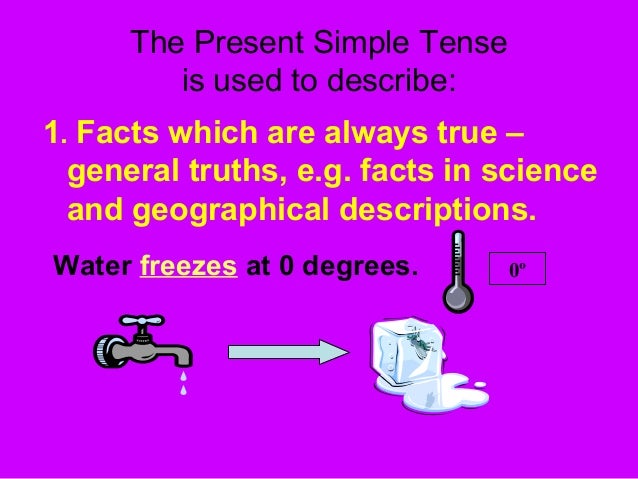
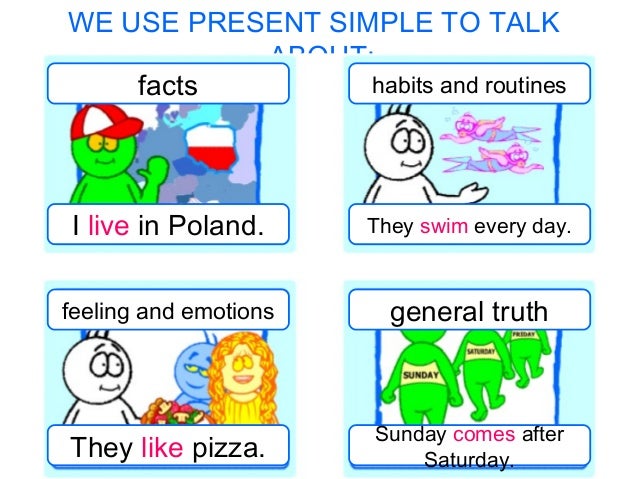
The simple present tense in English is used to describe an action that is regular, true or normal.
We use the present tense for:

1. Repeated or regular actions in the present time period.
  • I take the train to the office.
  • The train to Berlin leaves every hour.
  • John sleeps eight hours every night during the week.

2. Facts.
  • The President of The USA lives in The White House.
  • A dog has four legs.
  • We come from Switzerland.
3. For habits and routines.
  • I get up early every day.
  • Carol brushes her teeth twice a day.
  • They travel to their country house every weekend.
4. Things that are always / generally true.
  • It rains a lot in winter.
  • The Queen of England lives in Buckingham Palace.
  • They speak English at work.

Verb Conjugation & Spelling

We form the present tense using the base form of the infinitive (without the TO).
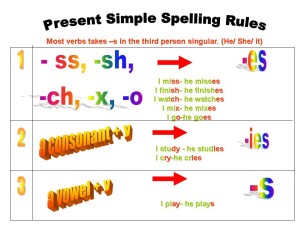
In general, in the third person we add 'S' in the third person.
SubjectVerbThe Rest of the sentence
I / you / we / theyspeak / learnEnglish at home
he / she / itspeaks / learnsEnglish at home

The spelling for the verb in the third person differs depending on the ending of that verb:
1. For verbs that end in -O, -CH, -SH, -SS, -X, or -Z we add -ES in the third person.
  • go – goes
  • catch – catches
  • wash – washes
  • kiss – kisses
  • fix – fixes
  • buzz – buzzes
2. For verbs that end in a consonant + Y, we remove the Y and add -IES.
  • marry – marries
  • study – studies
  • carry – carries
  • worry – worries
NOTE: For verbs that end in a vowel + Y, we just add -S.
  • play – plays
  • enjoy – enjoys
  • say – says

Negative Sentences in the Simple Present Tense

To make a negative sentence in English we normally use Don't or Doesn't with all verbs EXCEPT To Be and Modal verbs (can, might, should etc.).
  • Affirmative: You speak French.
    Negative: You don't speak French.
You will see that we add don't between the subject and the verb. We use Don't when the subject is I, you, we orthey.
  • Affirmative: He speaks German.
    Negative: He doesn't speak German.
When the subject is he, she or it, we add doesn't between the subject and the verb to make a negative sentence. Notice that the letter S at the end of the verb in the affirmative sentence (because it is in third person) disappears in the negative sentence. We will see the reason why below.

Negative Contractions

Don't = Do not
Doesn't = Does not
I don't like meat = I do not like meat.
There is no difference in meaning though we normally use contractions in spoken English.

Word Order of Negative Sentences

The following is the word order to construct a basic negative sentence in English in the Present Tense using Don't orDoesn't.
Subjectdon't/doesn'tVerb*The Rest of the sentence
I / you / we / theydon'thave / buy
eat / like etc.
cereal for breakfast
he / she / itdoesn't
* Verb: The verb that goes here is the base form of the infinitive = The infinitive without TO before the verb. Instead of the infinitive To have it is just the have part.
Remember that the infinitive is the verb before it is conjugated (changed) and it begins with TO. For example: to have, to eat, to go, to live, to speak etc.
Examples of Negative Sentences with Don't and Doesn't:
  • You don't speak Arabic.
  • John doesn't speak Italian.
  • We don't have time for a rest.
  • It doesn't move.
  • They don't want to go to the party.
  • She doesn't like fish.

Questions in the Simple Present Tense

To make a question in English we normally use Do or Does. It has no translation in Spanish though it is essential to show we are making a question. It is normally put at the beginning of the question.
  • Affirmative: You speak English.
    Question: Do you speak English?
You will see that we add DO at the beginning of the affirmative sentence to make it a question. We use Do when the subject is I, you, we or they.
  • Affirmative: He speaks French.
    Question: Does he speak French?
When the subject is he, she or it, we add DOES at the beginning to make the affirmative sentence a question. Notice that the letter S at the end of the verb in the affirmative sentence (because it is in third person) disappears in the question. We will see the reason why below.
We DON'T use Do or Does in questions that have the verb To Be or Modal Verbs (can, must, might, should etc.)

Word Order of Questions with Do and Does

The following is the word order to construct a basic question in English using Do or Does.
Do/DoesSubjectVerb*The Rest of the sentence
DoI / you / we / theyhave / need
want etc.
a new bike?
Doeshe / she / it
*Verb: The verb that goes here is the base form of the infinitive = The infinitive without TO before the verb. Instead of the infinitive To have it is just the have part.
Remember that the infinitive is the verb before it is conjugated (changed) and it begins with TO. For example: to have, to eat, to go, to live, to speak etc.
Examples of Questions with Do and Does:
  • Do you need a dictionary?
  • Does Mary need a dictionary?
  • Do we have a meeting now?
  • Does it rain a lot in winter?
  • Do they want to go to the party?
  • Does he like pizza?

Short Answers with Do and Does

In questions that use do/does it is possible to give short answers to direct questions as follows:
Sample QuestionsShort Answer
(Affirmative)
Short Answer
(Negative)
Do you like chocolate?Yes, I do.No, I don't.
Do I need a pencil?Yes, you do.No, you don't.
Do you both like chocolate?Yes, we do.No, we don't.
Do they like chocolate?Yes, they do.No, they don't.
Does he like chocolate?Yes, he does.No, he doesn't.
Does she like chocolate?Yes, she does.No, she doesn't.
Does it have four wheels?Yes, it does.No, it doesn't.
However, if a question word such as who, when, where, why, which or how is used in the question, you can not use the short answers above to respond to the question.

Let's review:

Activity:
  1. Read and write the text about below. 
  2. Use the verbs to complete the text. 
  3. Re-write the text in 3rd person singular.


CÓDIGOS PARA REGISTRO EN EDMODO

Buenos días queridos estudiantes de 7 y 8 grado. A continuación les dejo el código correspondiente a cada curso para que se registren en l...