Saturday, April 30, 2016

Simple Present Tense

Hi Guys of 8A, 8B, 8C, 8D and 8E, this information is about the simple present tense. Read it and write it in your notebooks.

The simple present tense in English is used to describe an action that is regular, true or normal.
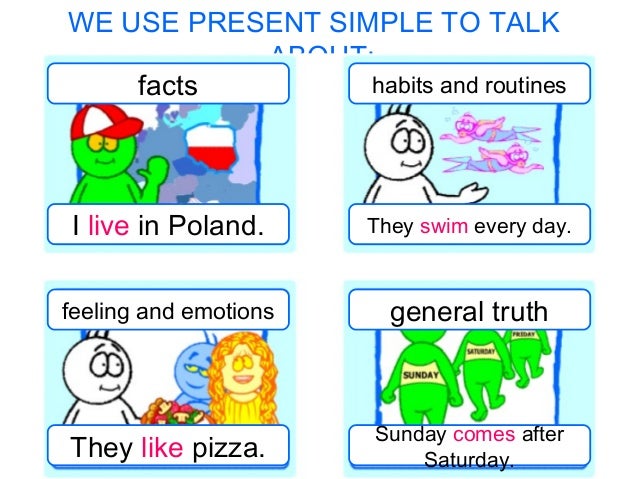
We use the present tense for:

1. Repeated or regular actions in the present time period.
  • take the train to the office.
  • The train to Berlin leaves every hour.
  • John sleeps eight hours every night during the week.

2. Facts.
  • The President of The USA lives in The White House.
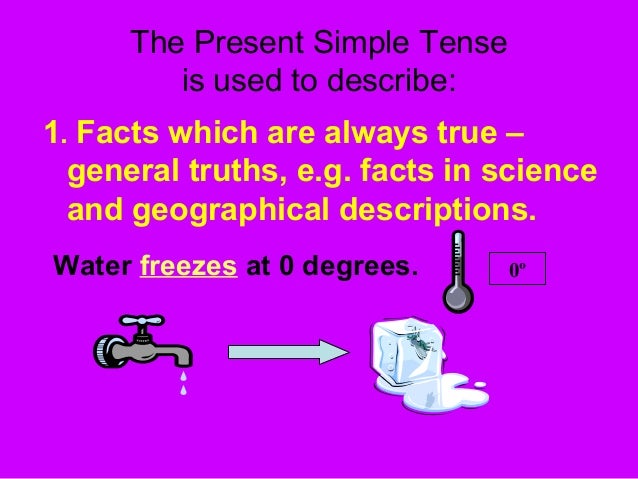
  • A dog has four legs.
  • We come from Switzerland.
3. For habits and routines.
  • get up early every day.
  • Carol brushes her teeth twice a day.
  • They travel to their country house every weekend.
4. Things that are always / generally true.
  • It rains a lot in winter.
  • The Queen of England lives in Buckingham Palace.
  • They speak English at work.

5. Feeling and emotions.
  • I dislike selfish people.
  • she hates Reggaeton music.

Verb Conjugation & Spelling

We form the present tense using the base form of the infinitive (without the TO).
In general, in the third person we add 'S' in the third person.
SubjectVerbThe Rest of the sentence
I / you / we / theyspeak / learnEnglish at home
he / she / itspeaks / learnsEnglish at home

The spelling for the verb in the third person differs depending on the ending of that verb:
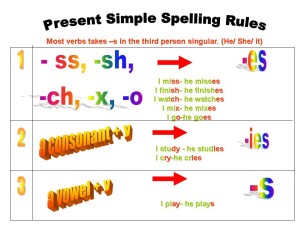
1. For verbs that end in -O, -CH, -SH, -SS, -X, or -Z we add -ES in the third person.
  • go – goes
  • catch – catches
  • wash – washes
  • kiss – kisses
  • fix – fixes
  • buzz – buzzes
2. For verbs that end in a consonant + Y, we remove the Y and add -IES.
  • marry – marries
  • study – studies
  • carry – carries
  • worry – worries
NOTE: For verbs that end in a vowel + Y, we just add -S.
  • play – plays
  • enjoy – enjoys
  • say – says

Negative Sentences in the Simple Present Tense

To make a negative sentence in English we normally use Don't or Doesn't with all verbs EXCEPT To Be and Modal verbs (can, might, should etc.).
  • Affirmative: You speak French.
    Negative: You don't speak French.
You will see that we add don't between the subject and the verb. We use Don't when the subject is Iyouwe orthey.
  • Affirmative: He speaks German.
    Negative: He doesn't speak German.
When the subject is heshe or it, we add doesn't between the subject and the verb to make a negative sentence. Notice that the letter S at the end of the verb in the affirmative sentence (because it is in third person) disappears in the negative sentence. We will see the reason why below.

Negative Contractions

Don't Do not
Doesn't = Does not
don't like meat = I do not like meat.
There is no difference in meaning though we normally use contractions in spoken English.

Word Order of Negative Sentences

The following is the word order to construct a basic negative sentence in English in the Present Tense using Don't orDoesn't.
Subjectdon't/doesn'tVerb*The Rest of the sentence
I / you / we / theydon'thave / buy
eat / like etc.
cereal for breakfast
he / she / itdoesn't
* Verb: The verb that goes here is the base form of the infinitive = The infinitive without TO before the verb. Instead of the infinitive To have it is just the have part.
Remember that the infinitive is the verb before it is conjugated (changed) and it begins with TO. For example: to have, to eat, to go, to live, to speak etc.
Examples of Negative Sentences with Don't and Doesn't:
  • You don't speak Arabic.
  • John doesn't speak Italian.
  • We don't have time for a rest.
  • It doesn't move.
  • They don't want to go to the party.
  • She doesn't like fish.

Questions in the Simple Present Tense

To make a question in English we normally use Do or Does. It has no translation in Spanish though it is essential to show we are making a question. It is normally put at the beginning of the question.
  • Affirmative: You speak English.
    Question: Do you speak English?
You will see that we add DO at the beginning of the affirmative sentence to make it a question. We use Do when the subject is Iyouwe or they.
  • Affirmative: He speaks French.
    Question: Does he speak French?
When the subject is heshe or it, we add DOES at the beginning to make the affirmative sentence a question. Notice that the letter S at the end of the verb in the affirmative sentence (because it is in third person) disappears in the question. We will see the reason why below.
We DON'T use Do or Does in questions that have the verb To Be or Modal Verbs (can, must, might, should etc.)

Word Order of Questions with Do and Does

The following is the word order to construct a basic question in English using Do or Does.
Do/DoesSubjectVerb*The Rest of the sentence
DoI / you / we / theyhave / need
want etc.
a new bike?
Doeshe / she / it
*Verb: The verb that goes here is the base form of the infinitive = The infinitive without TO before the verb. Instead of the infinitive To have it is just the have part.
Remember that the infinitive is the verb before it is conjugated (changed) and it begins with TO. For example: to have, to eat, to go, to live, to speak etc.
Examples of Questions with Do and Does:
  • Do you need a dictionary?
  • Does Mary need a dictionary?
  • Do we have a meeting now?
  • Does it rain a lot in winter?
  • Do they want to go to the party?
  • Does he like pizza?

Short Answers with Do and Does

In questions that use do/does it is possible to give short answers to direct questions as follows:
Sample QuestionsShort Answer
(Affirmative)
Short Answer
(Negative)
Do you like chocolate?Yes, I do.No, I don't.
Do I need a pencil?Yes, you do.No, you don't.
Do you both like chocolate?Yes, we do.No, we don't.
Do they like chocolate?Yes, they do.No, they don't.
Does he like chocolate?Yes, he does.No, he doesn't.
Does she like chocolate?Yes, she does.No, she doesn't.
Does it have four wheels?Yes, it does.No, it doesn't.
However, if a question word such as whowhenwherewhywhich or how is used in the question, you can not use the short answers above to respond to the question.

Let's review:

Activity:
  1. Read and write the text about below. 
  2. Use the verbs to complete the text. 
  3. Re-write the text in 3rd person singular.

Tuesday, April 5, 2016

Presente Continuo

Hola chic@s aqui les dejo la informaciĂłn sobre primer tema de este segundo periodo, el Presente Continuo. Leanlo detenidamente y luego cĂłpienlo en sus cuadernos.


Form (Forma)

Para formar el presente continuo se utiliza el verbo auxiliar “to be” y el gerundio (infinitivo + “-ing”) del verbo.
SujetoAuxiliar (to be)Gerundio
Iamtalking, eating, learning, doing, going…
he, she, itistalking, eating, learning, doing, going…
you, we, theyaretalking , eating, learning, doing, going…

Structure (Estructura)

1. Affirmative Sentences (Frases afirmativas)
Sujeto + verbo auxiliar (to be) + gerundio.
Ejemplos:
I’m talking. (Estoy hablando.)
He’s eating. (Está comiendo.)
They’re learning. (Están aprendiendo.)
2. Negative Sentences (Frases negativas)
Sujeto + verbo auxiliar (to be) + auxiliar negativo (not) + gerundio.
Ejemplos:
I’m not talking. (No estoy hablando.)
He’s not [He isn’t] eating. (No está comiendo.)
3. Interrogative Sentences (Frases interrogativas)
Verbo auxiliar (to be) + sujeto + gerundio?
Ejemplos:
Are you talking? (¿Estás hablando?)
Is he eating? (¿Está comiendo?)
Are they learning? (¿Están aprendiendo?)

Uses (Usos)

1. El presente continuo se utiliza para hablar sobre algo que está pasando en el momento en el que hablamos.
Ejemplos:
I’m studying now. (Estoy estudiando ahora.)
He’s eating at the moment. (Está comiendo en este momento.)
Is it raining? (¿Está lloviendo?)
2. TambiĂ©n lo usamos para hablar de algo que está sucediendo en la actualidad pero no necesariamente cuando hablamos. En este caso, se utilizan expresiones de tiempo como “currently”“lately” o “these days”.
Ejemplos:
They’re learning English. (Están aprendiendo inglĂ©s.)
She’s currently looking for a job. (Actualmente está buscando un trabajo.)
Are you working much lately? (¿Estás trabajando mucho Ăşltimamente?)
3. Usamos el presente continuo para hablar de algo que está ya decidido que se hará en el futuro prĂłximo. Su uso indica que es bastante seguro que lo planificado sucederá.
Ejemplos:
I’m going to the party tonight. (Voy a la fiesta esta noche.)
He’s not [He isn’t] coming to class tomorrow. (No viene a la clase manaña.)
Are you working next week? (¿Trabajas la semana que viene?)

Gerundios: excepciones


  • Cuando el infinitivo acaba en e, esta se elimina (aunque en el caso de ee, oe ye no hay cambios).
    Ejemplo:
    come – coming
    agree – agreeing
  • En palabras con una vocal de pronunciaciĂłn corta antes de la consonante final, se dobla la consonante final (excepto si termina en w, y o x, que no se duplicarán).
    Ejemplo:
    sit – sitting
    (pero: mix – mixing)
  • En inglĂ©s británico la l final tras una vocal se dobla siempre (no asĂ­ en inglĂ©s estadounidense).
    Ejemplo:
    travel – travelling (inglĂ©s británico), traveling (inglĂ©s estadounidense)
  • Al final de la palabra se remplaza ie por y.
    Ejemplo:
    lie – lying

Nota: Hay unos verbos que no solemos usar en los tiempos continuos. 
SENSACIÓN / PERCEPCIÓN
  • to feel*
  • to hear
  • to see*
  • to smell
  • to taste
OPINIÓN
  • to assume
  • to believe
  • to consider
  • to doubt
  • to feel (= pensar)
  • to find (= considerar)
  • to suppose
  • to think*
ESTADOS MENTALES
  • to forget
  • to imagine
  • to know
  • to mean
  • to notice
  • to recognise
  • to remember
  • to understand
EMOCIONES / DESEOS
  • to envy
  • to fear
  • to dislike
  • to hate
  • to hope
  • to like
  • to love
  • to mind
  • to prefer
  • to regret
  • to want
  • to wish
MEDIDAS
  • to contain
  • to cost
  • to hold
  • to measure
  • to weigh
OTROS
  • to look (=parecerse a)
  • to seem
  • to be (en la mayorĂ­a de los casos)
  • to have(cuando significa "poseer")*
EXCEPCIONES
Los verbos de sensaciĂłn y percepciĂłn (see, hear, feel, taste, smell) suelen utilizarse con can: I can see... Pueden tomar la forma progresiva pero, en este caso, su significado suele variar.
  • This coat feels nice and warm. (percepciĂłn de las cualidades del abrigo)
  • John's feeling much better now (está mejor de salud)
  • She has three dogs and a cat. (posesiĂłn)
  • She's having supper. (está tomando)
  • I can see Anthony in the garden (percepciĂłn)
  • I'm seeing Anthony later (tenemos intenciĂłn de vernos)

Sunday, March 6, 2016

COMPARATIVES

By MAQUILO

Hi guys in this 2nd period you are going to learn and practise how to make comparisons. So here you are some important imformation about comparative degree.

Read it, write it on your English notebook and learn it well.
See you!

1. Grados de la comparaciĂłn
Antes de empezar, fĂ­jate en las siguientes frases:
Como ves el adjetivo tiene tres grados:
1. Positivo.
2. Comparativo: de igualdad, de superioridad
3. Superlativo.

Primero, aprenderemos a formar los adjetivos regulares (los que se rigen por unas reglas comunes) y después aprenderemos a construir oraciones comparativas. Finalmente, presentaremos los adjetivos irregulares (pocos, pero muy importantes).

1.1. Grado positivo de los adjetivos
Son los adjetivos tal y como los conocemos. Recordar que en inglés, a diferencia del español, los adjetivos se colocan delante de los nombres:
Ejemplos:
-happy birthday -cumpleaños feliz
-good job -bien hecho
-a beautiful house -una casa bonita
1.2. Grado comparativo de los adjetivos
Se subdivide en:

a. Comparativo de igualdad
b. Comparativo de superioridad.
c. Comparativo de inferioridad.

a. El comparativo de igualdad se emplea para comparar dos personas o cosas que tienen una cualidad en grado semejante. Para construir frases con comparativo de igualdad escribiremos: COMPARARTIVO DE IGUALDAD
(not) as + adjetive + as
(no) tan + adjetivo + como


b. El comparativo de superioridad se forma realizando determinados cambios en los adjetivos, atendiendo al nĂşmero de sĂ­labas que estos tengan. Para comparar siempre necesitamos un segundo tĂ©rmino, es decir, la comparaciĂłn siempre es entre dos o más cosas.

- Los adjetivos “cortos” de una sĂ­laba (monosĂ­labos) forman su comparativo de superioridad añadiendo –er:
slow Ă  slower
tall Ă  taller

Si el adjetivo monosílabo termina en consonante + vocal + consonante, éste dobla la última consonante:
big Ă  bigger
hot Ă  hotter
- Los adjetivos “cortos” de dos sĂ­labas que terminen en –y pasan a tener la terminaciĂłn –ier:
happy Ă  happier
heavy Ă  heavier
 

Si el adjetivo de dos sĂ­labas no termina en –y, se considera que es “largo” y forma su comparativo añadiendomore:
modern Ă   more modern  (más moderno)
crowded Ă  more crowded (más concurrido)

- Los adjetivos “largos” de tres o más sĂ­labas, tambiĂ©n forman el comparativo añadiendo more.
expensive Ă  more expensive   (más costoso)
interesting Ă  more interesting  (más interesante)


b. El comparativo de inferioridad se forma siempre poniendo less (menos) delante del adjetivo:
shy Ă  less shy  (menos tĂ­mido)
happy Ă  less happy  (menos feliz)
comfortable Ă  less confortable  (menos cĂłmodo)


CÓDIGOS PARA REGISTRO EN EDMODO

Buenos dĂ­as queridos estudiantes de 7 y 8 grado. A continuaciĂłn les dejo el cĂłdigo correspondiente a cada curso para que se registren en l...